Book Talks/Signings for “Chinese Laundries”
San Diego Chinese American History Museum, Aug. 11, 2007
Berkeley Chinese Community Church, Aug. 19. 2007
Calif. State University, Asian American Studies Program, Sept. 25, 2007
Lake Havasu City, Az. Writers Group, Mohave Community College, Jan. 19, 2008
Desert Jade Women’s Gp, Chinese Baptist Church, Phoenix, Az. Mar 1, 2008
Asian Pac Is Studies 200, Arizona State University, Tempe, Az. Mar. 3, 2008
Chinese Professional Club, Houston, Tx. April 11, 2008
Chinese American Museum, Chicago, Il, April 20, 2008
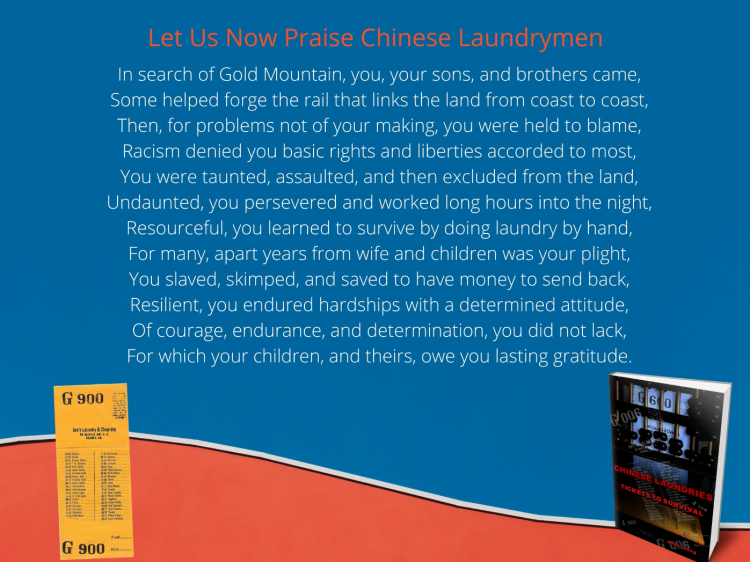
The laundry was the best, and at one time, the only, ‘ticket’ available to Chinese immigrants who came here starting in the middle of the 19th century to seek their fortunes on “Gold Mountain.” However, denied opportunities to most types of work by discriminatory barriers, the hand laundry became their economic lifeline, the meal ticket that enabled them and their descendants to overcome the obstacles confronting them to eventually achieve success on Gold Mountain.
Chinese laundries, born of necessity, became their stereotypical occupation, and in the early 20th century there was at least one located in virtually every town across the land. Today, however, they have all but vanished into history, made obsolete by social and technological changes. Their disappearance makes it all the more important to acknowledge the significant contribution that Chinese laundries made to the history of Chinese in North America. This book, Chinese Laundries, tells why and how Chinese laundries originated and determined the economic, psychological, and social status of the laundrymen and, for some, their families. First- and second-hand accounts of work and life in their laundries, where many lived in the back, help us see and appreciate how much they achieved despite racial prejudice, hardship, and cultural isolation.
Southern Fried Rice: Life in a Chinese Laundry in the Deep South
A personal story of my family’s laundry in Macon Ga., from 1928-1956 when we were the only Chinese in the entire city.
For more info and scholar comments: http://www.lulu.com/amazinggrace
To see a short tv interview about the book:
http://video.google.com/videoplay?docid=4681957987438873398&hl=en
Origins of Chinese laundries
The laundry came to be a stereotypical occupation for Chinese immigrants for over a century starting around 1850 before it disappeared into history as social and technological changes rendered it obsolete. Why and how did Chinese laundries come into existence and what was the role that they played on the economic and psychological status of Chinese immigrants and their families, both here and in China.
About 150 years ago, the first Chinese laundry in America is said to have opened when Wah Lee hung a sign that simply read “Wash’ng and Iron’g” in front of his shop in the Chinese quarter of San Francisco in the spring of 1851. From this inauspicious beginning, countless Chinese immigrants earned their living from hand laundries over the next century. By 1900, Chinese laundries dotted the American landscape in small and large cities and towns all across the country. The majority of Chinese men worked in or owned Chinese laundries, which for a while dominated the laundry business. But, today, there are few if any Chinese laundries still operating.
What factors led to the Chinese entering the laundry business and why did Chinese laundries become so prevalent that they became an ethnic group stereotype? When and why did these laundries begin to vanish and eventually disappear?
The story of Chinese laundries cannot be fully appreciated with first considering the historical and cultural context in which they developed. What circumstances led to the Chinese diaspora from Guangdong province in southeast China starting in the middle 19th century? Why did they emigrate to areas such as California, the Pacific Northwest, and Canada as well as to other distant parts of the world? What factors led to the discrimination and racism the Chinese soon encountered in all of these host countries that lead to laws excluding Chinese laborers from further immigration to the U.S. and Canada? How did the Chinese manage to still gain entry despite these adverse conditions?
What set of conditions created an unmet and unprecedented need for providers of laundry service? For centuries, washing and ironing clothes was considered women’s work done in homes, either by domestic servants or wives and mothers. It was physically demanding and time consuming work. Until plumbing was available there was no readily accessible water supply in the home for washing. Water gathered from a source had to be first heated to boiling temperature over a fire. Clothes had to be soaked and scrubbed by hand to remove dirt and stains. Then excess water had to be wrung out of articles by hand before it was hung up to dry by the wind, and sun when it was available. This tedious chore consumed one day while another day was spent ironing with heavy hand irons.
Not surprisingly, washing laundry was not a desired occupation. However, by the 1800s greater awareness and concerns about the diseases caused by germs increased the desire for clean clothes as well as bathing. In addition, being able to afford clean clothes became a marker of higher social standing. Finally, from a moral view, cleanliness became a virtue “next to Godliness.” All of these factors served to create an increasing need for laundry services.
In the frontiers of the west, women available to do laundry were few, and ships transported laundry to Hawaii for washing, a costly and time-consuming solution. In the large cities of the East, crowded housing conditions did not allow laundry to be done easily in residences, flats, and apartments. These conditions made it possible for the first time in history that doing laundry became a business opportunity. In a sense, denied entry to other work the Chinese immigrants of the mid-1800s got in on the ground floor of this occupation, which was unattractive to whites. Washing and ironing laundry day and night, week after week, and year after year was by no means an easy way to earn a living but it was the only option available to the Chinese then.
The Racism of ‘No Tickee, No Washee’
A Chinese laundry ticket is nothing more than a small piece of paper that serves as a claim check linking each customer with his laundry items. It has nothing to do with the actual provided services, yet the laundry ticket came to be a source for ridicule of the Chinese laundryman. Whites could not decipher the Chinese characters the laundryman recorded on the ticket to itemize and price the washed clothing articles. To whites, these ‘chicken feet scratches’ symbolized alien and inscrutable Oriental ways.
It is not all unreasonable for the laundryman to require the customer claiming laundry to present a ticket because without it, locating the customer’s clothing is made difficult. Furthermore, someone might claim clothing that did not belong to them. But no Chinese laundryman would have used the phrase, “No tickee, no washee,” or its other forms, “No tickee, no laundee”, or “No tickee, no shirtee” to make this point. The phrase is just one example of the way whites often fabricated pidgin English terms to make fun of the difficulty Chinese had in pronouncing English.
No one is sure how the term arose but it may have started with the 1903 story by a humorist, Calvin Stewart, in which Uncle Josh takes his clothes to a Chinese laundry. The narrator of the tale relates that:
“ … he giv me a little yaller ticket that he painted with a brush what he had, and I’ll jist bet a yoke of steers agin the holler in a log, that no livin’ mortal man could read that ticket; it looked like a fly had fell into the ink bottle and then crawled over the paper.”
Confused, he asked a man what the ticket was and he was conned, “Wall sir that’s a sort of a lotery ticket; every time you leave your clothes thar to have them washed you git one of them tickets, and then you have a chance to draw a prize of some kind.” Not wanting to enter the lottery, Josh sold the “lottery ticket” to the stranger for 10 cents. “…and in a couple of days I went round to git my washin’, and that pig tailed heathen he wouldn’t let me hev em, coz I’d lost that lotery ticket. So I sed — now look here Mr. Hop Soon, if you don’t hop round and git me my collars and ciffs and other clothes what I left here, I’ll be durned if I don’t flop you in about a minnit, I will by chowder.”
This type of confrontation between customers and laundrymen over picking up laundry without presenting a ticket was not uncommon. In the story, it was Uncle Josh, and not the laundryman, who was in the wrong. But the story is used to disparage the unfortunate laundryman who receives the unwarranted pummeling from Josh.
“No tickee, no laundree” has since come to be used as a catch-phrase for an impasse in many conflicted transactions quite unrelated to the Chinese or laundries. Even so the term still casts a derogatory tone toward Chinese and it is unfortunate that it remains in use even as Chinese laundries have almost disappeared from society.
The derisive, joking attitude surrounding the “Chinese laundry ticket” reflects the peception in America that Chinese laundrymen in particular, and Chinese in general, are odd or even ‘inscrutable’.